 Skip to content
Fencing for Schools and Parks: Visibility, Self-Closing Gates, and Safe Clearances
Choosing the right fencing for schools and parks isn’t just about drawing a line on the ground—it’s about keeping children and visitors secure, ensuring access for all, and complying with modern safety standards. For many homeowners and property managers, “Fencing for Schools and Parks: Visibility, Self-Closing Gates, and Safe Clearances” may seem overwhelming due to the many codes, options, and best practices involved. In the Chicago, Illinois area, these details matter even more, as weather and ordinances shape what truly works. This in-depth guide will demystify key requirements, present realistic trade-offs, and help you understand what to expect from your next fencing project. Along the way, we’ll use insights from Chicagoland Fence Pros, a leader in local fence installation, to ensure our advice is practical and actionable.
Why Fence Schools and Parks? Core Purposes and Safety Objectives
Before considering materials or features, it’s essential to understand why fencing is so critical for educational and recreational environments:
- Protecting children and users: Good fencing helps prevent wandering, unauthorized entry, and accidents.
- Defining safe play or learning zones: Clear boundaries support supervision and rule enforcement.
- Balancing access and safety: Robust gates and visibility panels keep spaces welcoming yet secure.
- Meeting legal and insurance mandates: Many local building codes and insurers require specific safety features, such as self-closing gates and minimum visibility standards.
Key Requirements: Visibility, Self-Closing Gates, Safe Clearances
Three features shape all code-compliant school and park fences:
- Visibility: Ensures that staff can supervise children without physical obstruction while still deterring trespassers.
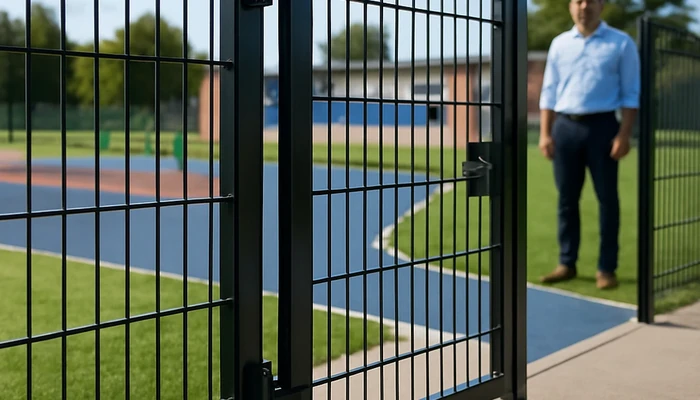
- Self-closing and self-latching gates: Critical for securing perimeters, especially in playgrounds and sports facilities. This feature prevents accidental open gates and reduces risk of unsupervised egress.
- Clearances: Safe gaps under and between fence pickets/panels to prevent climbing or head/limb entrapment, tailored to children’s safety regulations.
These principles help shape nearly every modern fencing decision in educational and park settings. For more details on gate design standards, reference ADA accessibility guidelines.
Types of Fencing Used in Schools and Parks
Different locations and user groups demand different solutions. Common types include:
- Chain-Link Fencing: Durable, affordable, high-visibility. Ideal for large perimeters but may require additional privacy slats where needed.
- Welded Wire Mesh Fencing: Offers a balance of security and visibility with smaller openings, deterring climbing.
- Ornamental Iron or Aluminum Fencing: Excellent for aesthetic appeal, longevity, and strength. Can be customized for safe picket spacing and capped finishes.
- Composite or Vinyl Fencing: Attractive and low-maintenance; best for certain play areas, though visibility should be carefully considered.
- Wood Fencing: Offers privacy but requires careful planning for picket spacing and more frequent maintenance in climates like Chicago.
Each type brings trade-offs in cost, durability, appearance, and compliance. See our Comparison Of Commercial Fencing For Different Industries for further details on industry best practices.
Visibility: Seeing Is Believing for Safer Spaces
Visibility isn’t simply for supervisors—it improves overall security and community comfort. Research shows transparent fencing deters unwanted visitors and enhances adult supervision. Consider these when deciding:
- Mesh or chain-link styles offer top sightlines, making staff supervision and emergency response easier.
- Solid fences, while private, can block views and may create hidden zones—use with caution, especially near play equipment.
Visibility needs also depend on the site’s location and risk level—urban Chicago campuses may favor increased transparency, while rural settings may prioritize privacy. More detail on balancing safety with aesthetics appears in this guide about safety, aesthetics, and functionality.
Self-Closing and Self-Latching Gates: Gateways to Security
A top cause of accidents in parks and schools is unlatched or open gates. Here’s why self-closing gates are now standard:
- Automatically close and latch behind users, preventing unintended exits.
- Reduced risk of propped-open or forgotten gates.
- Enables code compliance for pool areas, sports fields, and special needs access.
Effective gates are:
- Placed away from hazards (streets, parking lots).
- Equipped with child-resistant latches, well above small children’s reach, but compliant with ADA rules—see more at ADA.gov.
- Integrated with security systems for sensitive properties.
Consider automatic options and electronic access controls in higher-risk or larger facilities. For advanced gate solutions in Chicago, visit this page on automatic security gates.
Safe Clearances and Anti-Climb Features
Maintaining safe clearances is crucial to prevent climbing, squeezing through, or accidental entrapment. Consider:
- Picket spacing: Should not exceed 4 inches for young children’s safety.
- Gap beneath the fence: Should not allow for head or body passage. In most codes, 2 inches or less is standard.
- Fence height: For schools and play areas, 4–6 feet is typical; higher for sports courts or busy urban sites.
- Bolt heads and fasteners: Should not protrude or create snag hazards.
- Anti-climb mesh or angled tops: Especially in high-risk areas.
Always reference your local codes or consult with specialists like Chicagoland Fence Pros for details.
Material Choices and Long-Term Durability
Fencing in Chicago must handle extreme weather and busy public use. Here’s how common materials hold up:
| Material | Visibility | Durability | Maintenance | Best Use Case |
|---|---|---|---|---|
| Chain-Link | High | Excellent | Low | Perimeters, sports, large play areas |
| Wire Mesh | High | Excellent | Low to Moderate | Parks, schools, anti-climb needs |
| Ornamental Iron | Medium-High | High | Moderate | Entryways, prestige parks |
| Vinyl/Composite | Medium | Good | Low | Smaller play areas, decorative zones |
| Wood | Varies | Fair-Good | Moderate-High | Privacy zones (use sparingly for public play) |
For a full breakdown, compare maintenance requirements in the maintenance guide and see how durability impacts sports facilities at fencing for sports facilities.
Cost Considerations and Budgeting Realistically
Budgeting for schools and parks comes with its own realities:
- Most perimeter fences cost $18–$40 per linear foot depending on material, height, and site conditions (ranges only; local pricing in Chicago may differ).
- Gates with self-closing/latching hardware add to the upfront investment—expect $1,100–$2,500 per specialty gate.
- Long-term costs are lower for low-maintenance materials like vinyl and powder-coated steel, but upfront costs may be higher than chain-link.
- Always factor in professional installation, which ensures code compliance and warranty coverage.
For a more detailed look, see the benefits of commercial fencing for value and lifecycle insights.
Understanding Local Codes, ADA Accessibility & Legal Compliance
Chicago building codes and national ADA requirements directly impact fence design, especially regarding access and inclusion. Key points:
- Self-closing mechanisms and accessible latch heights are typically mandated for any public-use gates.
- Accessible pathways must be at least 36 inches wide and level, with compliant surface transitions.
- For parks and schools, codes require visible sightlines for supervision while still enclosing the area entirely.
- Check all municipal and state rules before installing: some require project permits and post-inspection for schools and parks.
- For more info, see ADA standards for accessible gates.
Tip: In the Chicago, Illinois area, always confirm with a licensed, insured fence contractor and review all code specifics relevant to your property before breaking ground. For a full breakdown of legal requirements, read legal requirements for commercial fencing.
Maintenance Expectations: Keeping Fences Safe Year-Round
School and park fences experience tough use and harsh weather. Minimize issues by:
- Choosing rust-resistant or powder-coated materials.
- Scheduling annual hardware and gate checks (especially for self-closing function).
- Inspecting clearances and repairing damage promptly to prevent safety risks.
- Reviewing local guidelines for routine playground or sports field safety audits.
For more tips, see our maintenance guide.
Common Mistakes to Avoid With School and Park Fencing
- Installing solid panels where adult supervision is essential (reduces safety).
- Skipping self-closing gates—manual-only options are rarely code-compliant.
- Ignoring anti-climb features on perimeters near busy roads.
- Neglecting local codes: even the best fence may be rejected if it fails inspection.
- Overlooking accessibility: gates too narrow or with poorly placed latches may violate ADA rules.
Always plan with long-term safety and compliance in mind—shortcuts often lead to costly rework.
Design Considerations: Blending Safety, Function, and Aesthetics
Modern fence design can offer both beauty and secure function. When choosing:
- Favor fence colors and finishes that reflect school or municipal branding while maintaining clear sightlines.
- Consider upgrading main entry gates and decorative panels for high-visibility areas.
- Blend different materials for areas with varying risk profiles—for example, ornamental iron fronts paired with chain-link on play fields.
Need ideas? See stylish and functional commercial fencing solutions for inspiration.
Integrating Fencing With Security Systems
For some Chicago area schools or parks, advanced options like access controls, security cameras, and electronic monitoring make sense. Integration planning tips:
- Include wiring conduits for gates or electronic latches in the initial design.
- Choose materials that accommodate sensors or cameras without interfering with visibility.
- Coordinate with local emergency access requirements.
See this deep dive into integrating fencing with security for advanced guidance.
Table: Quick-Reference Checklist for Fences in Schools & Parks
| Feature | Why It Matters | What To Check |
|---|---|---|
| Visibility | Supervision, safety, compliance | Transparent or mesh panels; avoid solid near play areas |
| Self-Closing Gates | Perimeter security, child safety | Code-compliant latches, regular checks, ADA accessible |
| Clearances | No climbing/trapping | Picket spacing < 4” and ground gap < 2” |
| Material | Durability vs. cost | Weather-resistant, powder-coated, code-compliant |
| Maintenance | Ongoing safety | Annual inspections, prompt repairs |
| Code Compliance | Legal/insurance | Review city ordinances, permits, ADA rules |
FAQ: School and Park Fence Safety, Codes, and Best Practices
What is the safest fence type for a school playground?
Welded wire mesh or powder-coated chain-link fences are usually the safest. They offer strong, see-through boundaries and can be fitted with self-closing gates and secure latches. Always follow local codes for picket spacing and gate hardware.
Are self-closing gates required by law in public parks?
Often, yes. Most municipal and state codes require self-closing and self-latching gates in areas used by children, especially around pools and play zones. Check with local authorities or review ADA standards for specific requirements relevant to your site.
How high should school or park fences be?
Most codes recommend at least 4 feet for schoolyards and public parks, increasing up to 8 feet near sports facilities or high-risk perimeters. The specific height will depend on location, local regulations, and risk assessment.
How do I ensure my school fence meets ADA accessibility rules?
Fences and gates should include an accessible pathway (at least 36 inches wide) and ensure gate latches are reachable by individuals with disabilities, typically between 34–48 inches above ground. For full compliance details, consult ADA.gov or a specialist fence contractor.
What are anti-climb features and do I need them?
Anti-climb features include tight mesh, arched or pointed tops, or horizontal rails located low enough to prevent being used as footholds. These are critical for busy schools, parks near traffic, or facilities needing additional security.
Can I use wood or vinyl for school fencing?
Yes, but these materials require careful picket spacing for safety and more frequent maintenance. In Chicago’s climate, composite and vinyl are popular for decorative areas, while chain-link and steel are often better for high-traffic or security-focused zones.
What is the best way to maintain a fence around a playground?
Annual inspections are key—check for loose panels, faulty gate hardware, and rust or splinters. Clear any obstructions and repair damage promptly. For products with a coating, follow the manufacturer’s cleaning and touch-up recommendations.
How can I get professional help with fence selection?
Reach out to local experts with experience in code-compliance, such as Chicagoland Fence Pros, to discuss your site needs and receive guidance tailored to your location and budget.
Do insurance companies care about fence features?
Yes—many insurers require self-closing gates, anti-climb designs, or specific heights to minimize liability and risk. Fences that fail to meet these standards may raise premiums or invalidate coverage.
Conclusion: Building Safer, Code-Compliant Spaces for All
Whether planning for a playground, park, or community school, the right fencing choices directly improve safety and peace of mind. Consider visibility, self-closing gates, and safe clearances as starting points—then balance security, compliance, and aesthetics for a fence that truly works long-term.
Ready to talk through your next project? Contact Chicagoland Fence Pros for honest advice or request a fencing estimate for your park, playground, or school in the Chicago area. For further reading, visit our guides on exploring the world of commercial fencing and comprehensive industrial fencing.
About Chicagoland Fence Pros
Chicagoland Fence Pros is a professional fence company with over 15 years of experience helping homeowners, schools, and businesses in Chicago, Illinois and nearby communities improve security, privacy, and curb appeal. The team specializes in wood, vinyl, aluminum, steel, and composite fencing for residential and commercial projects. All work is code-compliant, fully licensed and insured, with a focus on honest advice and quality craftsmanship.
fence contractor near chicago, business fencing Fence Installation Chicago, security fence Fence Installation Chicago, industrial fencing Buffalo Grove, business fencing Des Plaines, commercial fence Andersonville, commercial fence repair Addison, access control fence Schiller Park, business fence Rolling Meadows, security fence Westchester
