 Skip to content

Crash-Rated vs Decorative Bollards for Chicago Storefronts
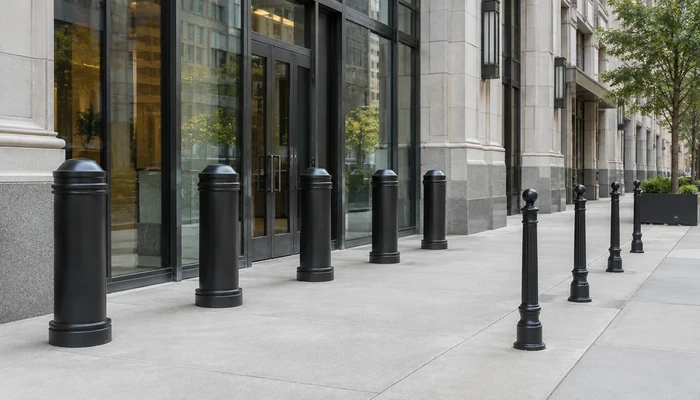
A row of posts outside a storefront may be intended to guide foot traffic, protect a display window, or help stop a vehicle. Those goals are not interchangeable. The difference matters when comparing Crash-Rated vs Decorative Bollards for Chicago Storefronts: a product’s appearance alone does not show whether it has been tested to resist a vehicle impact.
Crash-rated bollards are selected around a defined impact-performance requirement. Decorative bollards are chosen primarily for appearance, pedestrian guidance, or light-duty separation, and should not be assumed to stop a vehicle. Some products combine both functions, but the claimed performance depends on the tested system and its installation—not just the visible post.
This guide explains the terms, what ratings can and cannot tell you, how to think about layout and foundations, and which questions to take to a designer, supplier, or qualified installer. It is educational, not a site-specific engineering or code determination. In the Chicago, Illinois area, project conditions, applicable rules, and approvals can vary by property and location. Chicagoland Fence Pros encourages property owners to verify requirements before making decisions about perimeter protection.
Start with the job the bollards need to do
Before comparing models, describe the risk and the everyday function. A storefront may need to keep parked cars from crossing a pedestrian zone, protect a vulnerable opening, mark a boundary, or simply create a consistent streetscape. One installation can address more than one goal, but it is important to separate visual guidance from impact protection.
For example, a low-speed parking misjudgment in a controlled private lot is not the same design problem as a vehicle approaching a building at speed. Neither should be treated as a universal scenario: the site, access, vehicle path, and consequences of an impact all matter. A qualified designer can help convert a general concern into a performance requirement.
- Pedestrian guidance: Posts make a walkway edge or entrance easier to see.
- Access control: Fixed or removable posts help manage where vehicles may enter.
- Property protection: A properly specified system may be intended to resist a defined vehicle impact.
- Visual coordination: Finish, shape, spacing, and height contribute to the storefront’s appearance.
These purposes can overlap, but they should not be confused. Decorative posts may guide pedestrians effectively while offering no verified crash performance. A crash-rated installation may protect a designated area, yet still require separate attention to accessibility, circulation, and visual fit.
What “crash-rated” means—and what it does not
A crash-rated bollard system has been tested against a stated vehicle-impact condition or evaluated to a specified performance standard. A rating usually describes a particular combination of vehicle mass, test speed, impact conditions, and stopping or penetration result. The exact criteria depend on the test method and the product documentation.
The word “rated” is not a promise that a post will stop every vehicle in every real-world event. Performance claims apply to the tested configuration and stated conditions. An impact involving a heavier vehicle, a different speed, an angled approach, altered soil, or an installation that differs from the tested details may produce a different result.
Ask for the evidence behind a rating
When someone describes a product as crash-rated, ask for the specific rating or test standard and the documentation that supports it. Useful records may identify the tested bollard, foundation, spacing, installation depth, substrate, and test outcome. A product brochure or general statement about strength is not equivalent to a documented impact test.
Check whether the proposed configuration matches that evidence. A test for one model, foundation, or layout does not automatically validate another. If a project proposes substitutions or changes, ask the responsible designer or manufacturer to confirm whether the performance claim still applies.
For a broader overview of site planning and installation decisions, see factors to consider when planning bollards. The article is a starting point for questions, not a substitute for product-specific engineering.
How decorative bollards differ
Decorative bollards are typically selected for their visual character and practical, non-impact roles. They can define an edge, help organize pedestrian movement, protect landscaping from routine encroachment, or complement a building’s materials. They may be made in many shapes and finishes, but an attractive or heavy-looking post is not proof of crash resistance.
Some decorative models are also part of tested impact-resistant systems. In that case, the appearance is only one attribute; the relevant performance must still be backed by documentation for the exact assembly and installation. Conversely, a post sold as ornamental should be treated as ornamental unless reliable records say otherwise.
Decorative choices can include a simple smooth profile, a traditional cast look, a color-matched sleeve, or a design that echoes nearby rails and façade details. Style guides can help with visual ideas. For example, this overview of decorative bollard styles focuses on design considerations rather than verifying a particular product’s impact performance.
Comparison at a glance
| Consideration | Crash-rated system | Decorative bollard |
|---|---|---|
| Primary purpose | Resist a defined vehicle-impact condition, when correctly specified and installed | Visual definition, pedestrian guidance, or light-duty separation |
| Evidence to request | Test or rating documentation for the proposed assembly and conditions | Product specifications, finish information, and intended-use guidance |
| Appearance | May be utilitarian or designed with architectural finishes | Often offers a broad selection of shapes, colors, and styles |
| Installation sensitivity | High; foundation, spacing, substrate, and layout may be part of the tested system | Still requires suitable anchorage and coordination, but impact performance should not be presumed |
| Best next question | Does the exact proposed system meet the documented site requirement? | Is visual guidance all that is required, or is verified impact protection also needed? |
The table is a screening tool, not a specification. There is no single answer for every storefront. If the consequence of a vehicle entering a space could be serious, do not choose a product based on appearance or price alone; establish the required performance with an appropriate professional.
Choosing a system: a practical decision path
A simple decision process can keep early discussions focused. It also helps owners avoid comparing products that solve different problems.
- Describe the exposure. Identify nearby parking, drive aisles, loading areas, streets, and the path a vehicle could take toward the protected area.
- Define what needs protection. Mark the entrance, glazing, outdoor seating, pedestrian route, equipment, or other area of concern.
- Set the performance need. Ask a qualified designer or relevant authority whether a documented impact rating is required and which test conditions apply.
- Review the full assembly. Confirm the bollard model, foundation, reinforcement if applicable, spacing, embedment, and substrate against the supporting documentation.
- Coordinate the site details. Check access, visibility, walking routes, drainage, utilities, and any approvals before finalizing the layout.
- Choose the finish and upkeep plan. Select a finish and material suited to exposure and maintenance expectations without changing the required performance.
This order matters. Starting with color or a catalogue image can lead to a design that looks right but does not meet the property’s actual need. Performance and safe circulation should shape the shortlist; aesthetics can then refine it.
Placement and spacing are part of the solution
Bollards work as a layout, not as isolated objects. Their position and spacing influence whether vehicles can pass through, whether pedestrians have a clear route, and whether the protected area is meaningfully separated. A row that leaves a wide opening may fail to guide traffic as intended; a row placed too close to an entrance may interfere with daily access.
There is no universal spacing rule suitable for every product and property. A tested crash-rated system may have specific layout limits. Decorative posts also need thoughtful placement so they do not create trip hazards, obstruct mobility devices, block sightlines, or make deliveries difficult.
Map real movement before fixing the layout
Walk the site at different times and consider how customers, staff, delivery vehicles, emergency responders, and maintenance crews use it. Note turning movements, curb cuts, doors, ramps, snow-storage areas, and locations where people naturally queue. A plan should account for normal use, not only the idealized line on a drawing.
Where a project includes a continuous pedestrian route, check applicable accessibility requirements and preserve clear, usable passage. Avoid assuming that a visually neat row is automatically accessible. Site-specific review is especially important when posts are near ramps, crossings, doors, or narrow sidewalks.
Foundations, soil, and hidden site conditions
The visible post is only one part of an installed bollard. The foundation transfers loads into the ground or structure, so its design can be central to impact performance. Soil conditions, pavement thickness, nearby structures, drainage, and underground utilities can all affect the feasible approach.
For a crash-rated system, ask whether the test documentation specifies a foundation size, depth, reinforcement, or concrete detail. A field change to those details may alter the system’s performance. Do not assume that a deeper hole or larger post automatically improves the result; changes should be reviewed by the responsible professional.
Concrete design and construction involve project-specific variables. The Structural Engineering Institute’s concrete resources provide general technical context, but they do not replace the project engineer’s drawings or local requirements.
Before excavation, identify underground services and confirm who is responsible for utility locating. Existing foundations, vaults, tree roots, and drainage lines may limit placement. If a proposed location conflicts with those conditions, a qualified designer should assess alternatives rather than relying on an improvised relocation.
Materials and finishes: appearance is not a performance rating
Bollards are made from different materials and can use sleeves or coatings to achieve a desired appearance. Material selection affects corrosion resistance, maintenance, impact behavior, repair options, and cost. But the material name alone does not establish that the complete product is crash-rated.
- Steel: Common in security applications and available in various finishes. Confirm the specified grade, wall or section details, corrosion protection, and tested configuration.
- Iron or steel with a decorative profile: Can complement traditional architecture. If impact protection is expected, verify that the exact assembly has supporting performance documentation.
- Concrete: May be used in fixed barriers or as part of a designed system. Its strength depends on the complete design and installation, not merely the material label.
- Polymer or composite covers: Can provide color and a replaceable outer appearance. A cover does not make an untested core a rated barrier; check the manufacturer’s details.
For steel exposed outdoors, coating selection and detailing can affect how well the surface resists corrosion. The American Galvanizers Association discusses design considerations for galvanizing, including how design choices relate to coating coverage and service conditions. Use the applicable product and project specifications when selecting a protection system.
Appearance can be tailored after the performance need is clear. Consider how the finish will look beside the storefront, how often it may need cleaning or touch-up, and whether a damaged sleeve or coating can be repaired or replaced. For ongoing care topics, see guidance on caring for outdoor iron bollards.
Chicago-area conditions and local review
In the Chicago, Illinois area, outdoor equipment must contend with seasonal temperature changes, precipitation, road salt, and repeated freeze-thaw conditions. These conditions can affect finishes, joints, surrounding pavement, and maintenance needs. They do not establish a particular crash rating, but they are worth including in material and upkeep discussions.
Local requirements can depend on the property, the work proposed, the street or sidewalk context, and the authority with jurisdiction. Check applicable building, zoning, right-of-way, accessibility, fire-access, and permit requirements with the relevant local agencies and project professionals. Do not assume a neighboring storefront’s layout is approved for another address.
Homeowners and property managers should also review property agreements, landlord requirements, and any applicable design rules. When a project touches public space or changes vehicle access, confirm who must review or approve the work before ordering materials.
Costs and scope: compare complete projects, not just posts
There is no reliable one-price answer for a storefront bollard project. Costs vary with the number of posts, product type, documented performance requirements, finish, foundations, excavation, utility conflicts, pavement restoration, access restrictions, engineering, permitting, and installation conditions. Estimates can change when hidden site conditions become clear.
A decorative post may have a lower purchase price than a tested impact-resistant system, but price comparisons are meaningful only when the products serve the same purpose. A quote that omits foundations or site restoration may not describe the same scope as one that includes them.
Ask for written clarification on:
- the bollard model and finish;
- whether a crash rating is specified and which documents support it;
- foundation and anchoring details;
- layout, spacing, and any design assumptions;
- utility locating, excavation, and pavement repair responsibilities;
- permits, inspections, and other approvals included or excluded;
- maintenance recommendations and warranty terms.
These questions make proposals easier to compare without treating the lowest initial price as the best overall choice. Any cost examples supplied by a contractor should be understood as estimates, not guarantees; site conditions and scope may change the final amount.
Maintenance, inspection, and damage
Routine inspection helps owners notice loose components, corrosion, cracked surrounding concrete, damaged coatings, or changes to the path around a post. The appropriate interval depends on the location, use, material, and manufacturer’s advice. High-traffic sites or areas exposed to road salt may need more frequent attention.
A practical inspection can include:
- checking for movement, leaning, or loosened hardware;
- looking for cracks or settlement around the base;
- noting rust, coating loss, impact marks, or water accumulation;
- confirming that access routes and sightlines remain clear;
- recording damage and arranging professional review when needed.
If a bollard has been struck, do not judge its structural condition by the visible surface alone. A post may appear intact while its anchorage or foundation has been affected. Keep people away from a suspected damaged barrier when appropriate and have it assessed by a qualified professional. Repairs or replacement should preserve any required performance documentation.
Common selection mistakes to avoid
Assuming weight or thickness proves impact resistance
A substantial appearance can create false confidence. Request evidence for a defined test or rating and confirm that the proposed product and installation match it.
Relying on a rating without checking its conditions
A rating applies to stated conditions. Confirm the vehicle and test criteria, result, spacing, foundation, and other installation details relevant to the claim.
Designing around a catalogue photo
Photos rarely show underground foundations, utility conflicts, accessible clearances, or turning paths. Use a site plan and professional review before fixing a layout.
Changing components without review
Substituting a post, sleeve, anchor, or foundation detail may affect the tested assembly. Ask the manufacturer or responsible designer to confirm any proposed change.
Ignoring how the storefront operates
Deliveries, customer entry, emergency access, snow management, and sidewalk use are part of a workable design. Map routine movement early to reduce avoidable conflicts.
When to bring in a professional
Professional input is especially important when a project seeks vehicle-impact protection, involves public space, requires excavation near utilities, changes accessible routes, or includes a vehicle strike or structural concern. A qualified designer can assess the risk, specify a suitable system, and coordinate documentation and approvals. An experienced installer can help confirm whether site conditions match the installation requirements.
When speaking with a supplier or installer, bring photographs, a simple site plan, measurements, information about nearby vehicle paths, and any relevant property or agency requirements. Ask who is responsible for design, product selection, permits, utility coordination, installation, and final inspection. Clear responsibility helps prevent gaps between a product claim and the finished work.
For information about installation planning, review these key bollard planning factors. If you are also considering perimeter fencing as part of a broader property plan, you can explore commercial fencing options separately; bollards and fences address different site needs.
Frequently asked questions
Can a decorative bollard stop a vehicle?
Do not assume it can. Decorative products may guide pedestrians or mark an edge, but vehicle-impact performance should be claimed only when supported by appropriate documentation for the exact product and installation.
Can a bollard be both decorative and crash-rated?
Yes, some systems combine an architectural appearance with documented impact performance. Verify that the rating applies to the proposed post, finish or sleeve, foundation, layout, and installation conditions.
Does “crash-rated” mean it will stop every vehicle?
No. A rating describes performance under stated test conditions. Vehicle size, speed, approach, surface, and installation differences can change real-world outcomes, so the rating is not a universal guarantee.
How can I confirm a crash-rating claim?
Ask for the test standard or rating, supporting report or manufacturer documentation, and the installation details required to achieve the stated result. Have the project professional confirm that the proposed configuration fits the site requirement.
How far apart should storefront bollards be?
There is no single spacing that works for every product and property. Follow the tested system’s design requirements when applicable, and coordinate openings with pedestrian access, vehicle movement, accessibility, and local review.
Are removable or retractable bollards automatically crash-rated?
No. The operating style does not establish impact performance. Check the documentation for the specific model and its installed condition, and confirm whether it meets the site’s intended use.
Do bollards always require concrete foundations?
Not necessarily. Anchorage depends on the product, substrate, and design. A crash-rated system may require a specific foundation assembly; follow approved product and project details rather than choosing an anchoring method by appearance.
What should I do if a bollard is hit?
Have it assessed before relying on it again, even if damage seems minor. Impact can affect hidden anchorage or concrete. A qualified professional can recommend inspection, repair, or replacement based on the system and its intended function.
Making a thoughtful storefront choice
The essential distinction in Crash-Rated vs Decorative Bollards for Chicago Storefronts is the documented job each system is designed to perform. Decorative bollards can support wayfinding and visual design; crash-rated systems are specified around tested impact performance and installation conditions. One should not be treated as a substitute for the other without evidence.
Define the risk, confirm the performance need, check the complete assembly, and coordinate placement with daily access and local requirements. In the Chicago, Illinois area, site conditions and approvals can differ from one property to another, so verify details before purchasing or excavating. For a broader property discussion, review iron bollard project options and ask qualified professionals to assess project-specific safety questions.
About Chicagoland Fence Pros
Chicagoland Fence Pros has over 15 years of experience installing fences in the Chicago, Illinois area. Chicagoland Fence Pros serves homeowners and businesses in Chicago, Illinois and nearby communities, with experience in wood, vinyl, aluminum, and steel fencing for residential and commercial projects. The team emphasizes clear guidance, realistic expectations, and attention to applicable codes and site requirements. Project-specific bollard performance and engineering should be confirmed with the appropriate qualified professionals.
fence company near chicago il, bollard repair Installation Chicago, iron bollards Installation Chicago, steel bollards Elgin, protective bollards Oswego, iron bollards Washington, security bollards Marengo, warehouse bollards Schiller Park, storefront bollards Vernon Hills, bollard repair Crystal Lake
