
The Role of Commercial Fences in Property Management: A Practical Guide
For property managers and owners, selecting the right commercial fence can be the difference between a secure, well-managed site and one susceptible to security lapses, privacy concerns, or ongoing maintenance headaches. The role of commercial fences in property management isn’t simply about boundaries – it’s woven deeply into issues of safety, aesthetics, compliance, and long-term property value. With so many available materials, designs, and local code considerations, first-time decision makers often find the landscape overwhelming.
This comprehensive guide demystifies your options as a property manager or owner, providing clear, experience-backed education on choosing, installing, and maintaining commercial fences. By the end, you’ll understand how these installations influence security, privacy, aesthetics, and day-to-day management in the Chicago, Illinois area and beyond. Whether upgrading an industrial perimeter or protecting a commercial campus, this post from Chicagoland Fence Pros gives you a realistic playbook for informed choices and lasting results.
What Defines the Role of Commercial Fences in Property Management?
Commercial fences go beyond marking a boundary – they act as an integral asset in the modern property manager’s toolkit. Their functions can range from keeping people or assets secure, defining access points, protecting sensitive areas, providing privacy, or even projecting a professional image.
- Security: Deter trespassers, prevent theft, and guide foot/vehicle traffic.
- Privacy: Shield business operations, sensitive equipment, or outdoor workspaces from public view.
- Regulatory Compliance: Ensure your property meets city codes, insurance requirements, and industry standards.
- Curb Appeal: Enhance the visual coherence and perceived professionalism of the site.
- Liability Reduction: Reduce hazards and delineate safe zones (for example, around pools or manufacturing yards).
Each of these goals connects directly with effective property management, balancing tenant needs, legal compliance, and long-term value.
Types of Commercial Fences: Materials and Use Cases
Not all commercial fences serve the same function, nor do they suit every site. Here are the most common material types and where they fit in property management:
| Material | Main Use Cases | Pros | Cons |
|---|---|---|---|
| Chain Link | Warehousing, schools, industrial, temporary partitions | Affordable, low maintenance, secure | Lower privacy, utilitarian look |
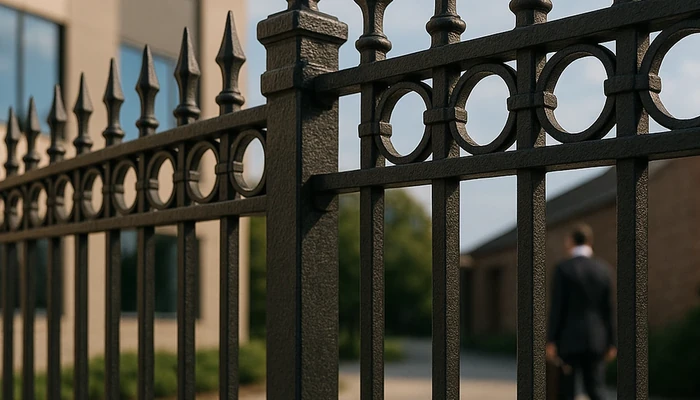
| Wrought Iron/Steel | Historic districts, institutions, high-security areas | Extremely durable, classic look, strong security | Higher upfront cost, may need maintenance |
| Aluminum | Commercial campuses, pool areas | Rust-resistant, versatile designs | Less sturdy than steel under heavy impact |
| Wood | Restaurants, daycares, multi-family housing | Natural beauty, privacy, customizable | High maintenance, can warp/rot over time |
| Vinyl | Retail sites, apartment complexes | Low maintenance, clean appearance, variety of styles | Less strength than metal against impact |
| Composite | Noise barriers, upscale complexes | Durable, eco-friendly, excellent privacy | Costlier installation, moderate maintenance |
For a more detailed breakdown, see our guide on comparing commercial fencing for different industries.
Security and Safety: Why They Matter in Property Management
Managing risk is core to property management, and a professionally designed fence serves as a first line of defense. Security fencing can deter opportunistic crime, create designated access points, and add additional barriers to sensitive infrastructure. For many businesses, insurance policies even require specified fencing to protect certain assets.
Some security enhancements include:
- Anti-climb mesh or infill panels
- Height and visibility (taller fences with clear sight lines)
- Reinforced panels, bollards, or crash-rated designs
- Access gates with electronic locks or automation (see automatic security gates)
Effective security isn’t just about the fence material – it includes thoughtful design integration and sometimes smart technology. Learn about integrating commercial fences with security systems to maximize overall protection. For fabrication details relevant to fence durability and standards, visit the American Galvanizers Association guidelines.
Enhancing Privacy and Curb Appeal
Not every fence is about strength: privacy is another cornerstone of broad property management strategies, especially for businesses handling sensitive operations or high-value inventory. Solutions like wood, vinyl, and composite panels—even living green barriers—can shield from visual intrusion while raising a site’s curb appeal. In the Chicago, Illinois area, balancing this privacy with code requirements and weather resistance is vital.
Explore more on curb appeal in our post on commercial fencing designs for curb appeal.
Compliance, Building Codes, and Industry Standards
Never underestimate the importance of local regulations. From maximum allowable heights to setbacks, privacy limitations, and required materials for specific zones, Chicago’s building codes set limits you must observe. Non-compliance can mean costly fixes or legal obstacles.
- Always check city ordinances before committing to a fence project.
- Industrial or high-security uses may require fencing to meet special certifications.
- Insist on professional installation to meet code and durability standards.
Deep-dive into legal requirements for commercial fencing before finalizing any design or budget. For electronic access and surveillance, refer to integration standards set by entities like ONVIF for compatibility and future-proofing.
Realistic Expectations: Costs, Lifespan, and Maintenance
Budgeting accurately requires an honest look at both upfront costs and ongoing care. Material and installation costs vary widely—higher-quality, code-compliant fences come with a larger initial outlay, but typically mean fewer repairs or replacements over time.
| Material | Approximate Lifespan | Maintenance Needs |
|---|---|---|
| Chain Link | 15–20 years | Annual inspection, minor patching |
| Wrought Iron/Steel | 20–50+ years | Paint/touch-up coatings, rust checks |
| Vinyl | 20–30 years | Occasional cleaning, inspect for cracks |
| Wood | 10–20 years | Stain/seal, replace boards as needed |
| Composite | 20–30 years | Wash panels, inspect fasteners |
These ranges are best-case scenarios. Storms, misuse, or deferred maintenance can shorten lifespans. See tips for maximizing performance in our maintenance guide. If you’re unsure which material will last or how to plan a repair, you can always request a professional assessment.
Balancing Security, Design, and Functionality: Best Practices
For a property manager or owner, the best fence combines secure, code-compliant design with an aesthetic suitable for the business’s brand. Achieve this by:
- Assessing property needs: location, risk profile, privacy, visibility, and traffic flow.
- Selecting materials: match durability to your climate and expected use (see fence durability in extreme conditions).
- Customizing design: blending security requirements with visual appeal.
- Planning access: secure gates, bollards, and possible automation (installing iron bollards).
- Confirming compliance: double-check zoning, city codes, and insurance needs.
For commercial projects in Chicago, weather resilience and snow load are important design factors—be sure to discuss these with your contractor.
Commercial Fencing Options and Innovations
Beyond traditional materials, some newer offerings are transforming the property management landscape:
- Modular fencing systems: Allowing rapid repairs or reconfiguration (learn about modular design).
- Noise-reducing panels: For sites near busy roads or industrial operations (noise reduction fences).
- Green/composite technologies: Providing eco-friendly alternatives with lower long-term maintenance needs (eco-friendly fence choices).
To keep up with these trends as well as traditional choices, see our world of commercial fencing resource.
When to Call a Professional Fence Contractor
While some simple repairs can be handled internally, most commercial fencing projects—especially those involving code compliance or integrated security—demand professional experience. A reputable contractor like Chicagoland Fence Pros will:
- Navigate local permitting and code enforcement
- Advise on the most durable, cost-effective materials for Chicago’s climate
- Plan installations to minimize operational downtime
- Offer transparent estimates that account for site-specific variables
Not sure what’s best for your property? Contact Chicagoland Fence Pros to discuss your needs or request a commercial fencing estimate for your property in the Chicago, Illinois area.
Frequently Asked Questions: The Role of Commercial Fences in Property Management
- Q: Why are commercial fences important for property management?
A: They provide essential security, ensure compliance, create privacy, and enhance the professional appearance of a property. Fencing can also reduce liability by discouraging trespassing. - Q: What fence types are best for maximizing security?
A: Wrought iron, steel, and reinforced chain link are excellent for security. Access-controlled gates and anti-climb panels further inhibit intrusion. Learn more about integrating security at this hub. - Q: How can I ensure my fence complies with Chicago regulations?
A: Start by reviewing local ordinances and zoning codes. Involve a licensed professional, like Chicagoland Fence Pros, familiar with Chicago requirements. - Q: What is the typical lifespan for commercial fencing?
A: Lifespans range from 10 to 50+ years depending on the material, local weather, and maintenance practices. See our cost/longevity table above for details. - Q: Should I choose privacy or security as the priority?
A: Evaluate your site’s exposure and risks; many fences now combine both characteristics with advanced materials and designs, customizing solutions for each property. - Q: Can smart technology be added to existing fencing?
A: Yes, many modern systems (e.g., electronic locks and surveillance) can be integrated with compatible fences. See standards from ONVIF. - Q: How do weather and climate affect fence choice in Chicago?
A: Cold, snow, and freeze/thaw cycles require durable, weather-resistant materials and strong foundations. Chicagoland Fence Pros specializes in installations proven for Midwest conditions. - Q: What ongoing maintenance is required?
A: Routine inspections, cleaning, and timely repairs (paint, fasteners, etc.) maximize lifespan. Annual checks are recommended. - Q: How soon after construction can my fence be used?
A: Most fence installations allow usage immediately after final inspection, but curing or settling time varies by material and complexity. - Q: Where can I see more examples or get advice?
A: Explore our resource pages or contact Chicagoland Fence Pros for personalized support.
Conclusion: The Right Fence is a Property Management Asset
Installing or updating a commercial fence is among the highest-impact improvements a property manager can make—directly influencing safety, curb appeal, site efficiency, and liability. In the Chicago, Illinois area, weather resistance and local code compliance add extra layers of decision-making, but with professional advice, the optimal solution is always within reach.
Ready to take the next step? Contact Chicagoland Fence Pros to talk to fence specialists, explore material options, or set up an estimate for your unique property management needs.
About Chicagoland Fence Pros
Chicagoland Fence Pros is a professional fence company with over 15 years of experience installing code-compliant, durable fencing for homes and businesses in Chicago, Illinois and nearby communities. Specializing in wood, vinyl, aluminum, steel, and composite materials, we deliver honest guidance, transparent pricing, and meticulous craftsmanship for every residential and commercial project. Fully insured and licensed, Chicagoland Fence Pros prioritizes safety, privacy, and compliance every step of the way.
fence builder chicago il, Chicago Commercial Fence Installation, Commercial Fence Installation in Chicago Il, security fence Hampshire, commercial fence repair East Ravenswood, business fencing North Center, commercial fence repair Rolling Meadows, access control fence Zion, warehouse fence Forest Park, commercial fence repair North Edgebrook