
Sloped Yard, Clean Finish: Step vs Racked vs Contoured Panels (What Looks Right)
Choosing the right fencing solution for a sloped yard can feel overwhelming. Homeowners and property managers often face confusion about how to achieve a clean, attractive finish when their property isn’t perfectly flat. The common fence installation techniques—step, racked, and contoured panels—can significantly impact your yard’s aesthetics, security, and maintenance needs. Many people wonder: Which looks best? Will one give you privacy, while another looks awkward? What are the real-world trade-offs for each style, especially in Chicago’s challenging climate?
This guide takes you deep into the differences between step, racked, and contoured fence panels for sloped yards. We’ll break down how each approach works, what to expect during installation, their pros and cons, and what “looks right”—so you can make a choice you’ll feel good about for years. By the end, you’ll have clear, honest insights—whether you’re planning DIY or hiring local pros like Chicagoland Fence Pros, with proven know-how for Chicago, Illinois properties. Let’s dive in and take the guesswork out of sloped yard fencing.
Why Sloped Yards Need Special Fence Design
Many yards in Chicago and suburban Illinois have uneven grades, visible slopes, or rolling terrain. Installing a fence here isn’t as simple as using the same panel style for every section. If you don’t account for the slope, you’ll likely end up with large gaps under fence sections, an uneven top line, or a wavy, “unfinished” look.
Well-designed sloped yard fences:
- Enhance curb appeal and property value
- Maintain privacy and security along the entire boundary
- Comply with local codes and neighbor agreements
- Reduce maintenance headaches due to erosion or shifting
Understanding your options—step, racked, or contoured—helps ensure you get the aesthetic and security you want, without costly surprises.
Key Terms Defined: Step, Racked, and Contoured Fence Panels
Before comparing the methods in depth, let’s clarify what each means:
- Step Fencing: Fence panels are installed level, but each section is placed slightly higher or lower—like steps—following the slope. This creates gaps under some sections and a “stair-step” appearance on the top rail.
- Racked Fencing: The fence panels are constructed to angle up or down with the slope, keeping the bottom flush with the ground. The pickets or vertical elements are aligned to adjust with the angle, resulting in a smooth top and bottom line.
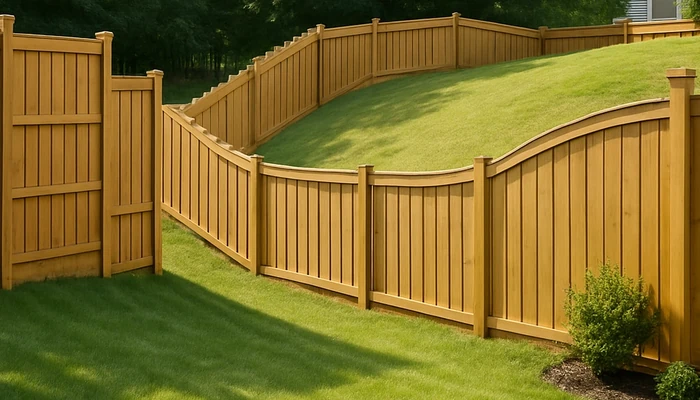
- Contoured (or Scalloped) Fencing: The fence is custom-built onsite to closely follow the exact contours of the ground, resulting in a flowing line that hugs even the most irregular slopes. Each picket may be cut to a different length, or the rails curved, to match the land precisely.
Table Comparison: Step vs Racked vs Contoured Fence Panels
| Feature | Step | Racked | Contoured |
|---|---|---|---|
| Appearance on Slope | Staggered “step” at panel tops | Smooth top and bottom following slope | Custom, flowing curves at ground line |
| Bottom Gaps | May leave substantial gaps | Minimal to no gap | Virtually no gaps, tightly follows ground |
| Materials Compatibility | Works with wood, vinyl, aluminum, chain link | Works best with metal or flexible panel systems | Usually wood or custom solutions |
| Labor/Complexity | Medium—measuring, leveling | Higher—custom panels or adaptable systems | Highest—custom onsite building |
| Visual Impact | Formal, geometric look | Sleek, continuous lines | Organic, blends with landscape |
| Code Compliance | Easy with pre-built panels | Requires careful layout for height limits | May need clear communication with inspectors |
| Best for… | Modest slopes, budget builds | Moderate slopes, premium appearance | Steep or highly uneven terrain |
Step Fencing Explained
Step fencing is one of the most traditional solutions for sloped yards in Illinois. Each fence panel is mounted level, but at each post, the next panel “steps up” or “down” to follow the property’s grade. This method is particularly common with pre-assembled panels for wood and vinyl fences, or where budget and ease of installation are top priorities.
When to Choose Step Fencing
- Moderate, steady slopes (not too steep)
- Need to use standard-sized or pre-built panels
- Preference for a classic, angular look
- Budget-sensitive projects
Pros
- Often the most economical solution
- Easy to plan and install with pre-made panels
- Less custom carpentry required
Cons
- Noticeable gaps under some panels, potentially allowing pets to escape or diminishing security/privacy
- Staggered top line may be less visually pleasing
- Not ideal for steep grades
From our experience as a fence company in Chicago, Illinois, step fencing is common on older properties and multi-family setups where function is more important than flawless aesthetics. However, creative landscaping and short retaining walls can minimize visible gaps under stepped sections.
Racked Fencing: A Smooth Solution for Slopes
Racked fencing uses specially designed panels that allow the pickets or rails to angle up or down, keeping the fence flush with the slope. This method eliminates gaps, while the top and bottom lines flow parallel with the ground.
When to Choose Racked Fencing
- Gently to moderately sloped yards seeking a polished look
- Desire for enhanced privacy and security (no large gaps)
- Investment in higher quality, adaptable fence materials (many metal systems, rackable vinyl or composite)
Pros
- Continuous look, with no stair-stepping at the top
- Excellent for pets, privacy, and security
- Improved water runoff, reducing risk of soil erosion
Cons
- Requires panels or systems designed specifically to be racked; not all materials are suitable
- Generally higher material and installation costs
- Requires more precise layout and skilled installation to meet codes and maintain appearance
Many modern fences around Chicago, especially premium metal, composite, and some vinyl systems, use racked panels for a seamless look on sloping lots. Racked fencing is particularly attractive in neighborhoods with visible front fences or where curb appeal matters.
For further design inspiration and to explore versatile products, see Versatile Wire Mesh Fence Panels and Creative Link Fence Designs.
Contoured Fencing (Scalloped) for Irregular Terrain
Contoured fencing goes a step further than racking by building the fence to match every dip, rise, and curve in your yard. Each picket or rail is cut to the specific height needed at its position, following the land’s natural shape. This gives your boundary a custom-made, almost hand-crafted look.
When to Choose Contoured Fencing
- Very steep or highly varied slopes
- Desire for a fully custom, seamless appearance
- Properties with landscaping features, berms, or localized bumps and dips
Pros
- Virtually eliminates bottom gaps
- Blends beautifully with the landscape
- Maximum flexibility for unique yards
Cons
- Most labor-intensive and expensive method
- Requires experienced carpenters or installers
- Challenging to maintain a perfectly level top line (unless specifically designed for it)
Contoured fencing is often used in luxury landscape projects or where property owners want a standout, “magazine-feature” yard. Chicagoland Fence Pros often sees this style for homes with custom gardens, historic lots with unique grades, or for clients who want something beyond standard panels.
Visual Examples: What Each Style Looks Like
If you drive through Chicago neighborhoods, you’ll see all three approaches. Here’s a practical visualization:
- Step Fencing: Each panel is unmistakably level; the top looks like a staircase as you look along the line of the yard. Works best with square pickets and rails.
- Racked Fencing: The fence ‘leans’ with the grade. No steps at the top; everything flows smoothly uphill or downhill, perfect for modern designs.
- Contoured Fencing: The fence bottom mirrors every change in the terrain, hugging the ground tightly—beautiful for complex landscapes or garden features.
When choosing, walk your property front to back. Visualizing these styles against your existing landscaping, hardscape, and the street view can help clarify what will “look right” for your home or business.
To see how custom work impacts value and appearance, visit Enhance Your Property’s Appeal: The Impact of a Good Fence.
Material and Style Considerations for Sloped Fence Panels
Your slope-friendly fence design is also shaped by material type and panel construction. Not all fences can be easily racked or contoured. Here’s how materials stack up:
| Material | Step (Yes/No) | Racked (Yes/No) | Contoured (Yes/No) |
|---|---|---|---|
| Wood (custom build) | Yes | Limited (with loose picket assembly) | Yes |
| Wood (pre-assembled panels) | Yes | No | Rarely |
| Vinyl | Yes | With rackable variants | No (unless custom-built) |
| Metal (aluminum, steel, iron) | Yes | Yes (many systems allow racking up to a point) | Requires custom fabrication |
| Chain Link | Yes | Yes | No |
As you review options, always check with your installer or manufacturer regarding panel adaptability for slopes. The right choice also depends on:
- Budget
- Desired height, privacy, and security goals
- Neighborhood guidelines and HOA requirements
- Local weather exposure (Chicago winters can be tough on wood and vinyl)
Cost and Maintenance: What to Expect
The labor and total cost for sloped yard fencing varies widely:
- Step method is usually most budget-friendly, but may require additional landscaping or filler boards under gaps.
- Racked/contoured methods often carry a premium due to labor and specialized materials, but can save on additional landscaping and offer longer-lasting appeal.
Maintenance also differs. Step fences may need more frequent attention to address soil washing out under gaps, while contoured fences require careful upkeep where the wood or metal closely contacts the ground. Racked fences often provide a balanced solution, minimizing ground contact while providing a neat appearance.
If you’re concerned about project cost or long-term value, check out Evaluating Fencing Installation Costs.
Permits, Codes, and Neighbor Relations in Chicago
Chicago, Illinois, like most municipalities, has codes regarding fence height, location, materials, and neighbor boundaries. With sloped yards, the “maximum permitted height” is usually measured from the lowest grade next to each post or section—meaning your step or racked design may need adjustment to stay within local limits.
- Always check with authorities or an experienced local installer prior to building.
- Get written neighbor agreements if your fence will be built on or near shared property lines.
- HOA and historic district guidelines may further restrict fence style and finish.
For a comprehensive process, visit Navigating Local Fence Regulations: A Step-by-Step Guide for Homeowners.
For technical standards and trusted fence industry resources, browse the American Fence Association.
Professional Tips: Slope-Friendly Installations
- Plan panel layout before digging posts. On slopes, post locations may need slight adjustments to maintain a consistent look.
- Dry-fit the panels. Setting them along the slope visually before permanent installation can save costly mistakes.
- Leave expansion/descent gaps for weather. Chicago’s freeze/thaw cycles can move soil—avoid zero-tolerance fits unless required for pets.
- Consider landscaping enhancements. Low shrubs or decorative gravel under gaps can disguise step-style openings.
- Discuss your needs honestly with your installer. The trade-offs between labor, finish, and longevity are real—good pros will explain your options.
Frequently Asked Questions: Sloped Yard Fencing
How do I know which fence style “looks right” for my yard?
The best style for your yard depends on your slope, budget, and priorities. Walk your yard while visualizing both step and racked styles. If you care most about a smooth line, racked and contoured are superior; for budget and ease, step fencing may suffice.
Are gaps under step fences a problem in Chicago?
They can be, especially for pet owners or if privacy is key. Landscaping, short retaining walls, or adding kickboards can help minimize gap issues.
Is racked fencing always more expensive?
Generally, yes—because panels must be designed to accommodate angling. Material and labor costs are both higher, but many find the result worth the investment for a seamless look.
Can I build a contoured fence myself as a DIY project?
Contoured fences require advanced carpentry and measuring skills. They’re not beginner DIY-friendly. If you attempt it, expect more time, material waste, and the need for custom cutting or fabrication.
Do these fence styles affect future property resale value?
Well-installed, code-compliant fences (especially racked or contoured) add to curb appeal and resale value. Poorly installed fences with visible gaps or errors can have the opposite effect.
Do building codes in Chicago limit my fencing options on a slope?
Yes. Max height is measured at the lowest adjacent grade, so check with your local office or installer before finalizing your plans.
Are there special fence materials that work best on slopes?
Rackable metal (like some aluminum or steel systems), flexible composite, and site-built wood fences are most adaptable. Pre-assembled panels are less forgiving on steeper grades.
Will snow, ice, or soil movement damage my sloped fence?
Chicago winters can definitely challenge fence integrity. Good drainage, high-quality posts, and careful installation minimize the risk. Consult with pros familiar with Chicago’s weather.
Can existing fences be modified to work better on a slope?
Depending on design, some step fences can be retrofitted with filler boards or landscaping. Major racking or contouring often requires replacement.
Who should I contact for an expert opinion or estimate?
For honest advice on options, material choices, and costs, reach out to professional installers with proven local experience—such as Chicagoland Fence Pros.
Conclusion: Making the Right Choice for Your Sloped Yard
Picking between step, racked, or contoured fence panels isn’t just about looks—each impacts privacy, maintenance, budget, and long-term satisfaction. Take time to walk your property, ask questions, and envision how each style will perform year round in Chicago’s variable climate.
Remember: Codes, neighbor relations, and practical pros/cons should all inform your decision. A well-chosen fence can boost both security and curb appeal for decades.
Ready to move forward? Request a fence estimate from local experts, or contact Chicagoland Fence Pros for honest, tailored advice on your sloped yard project.
About Chicagoland Fence Pros
Chicagoland Fence Pros brings over 15 years of professional experience to homeowners and businesses across Chicago, Illinois and nearby areas. Specializing in residential and commercial fence design, installation, and perimeter security, their fully insured team offers expertise in wood, vinyl, aluminum, and steel fences. Every project focuses on code compliance, long-term durability, honest advice, and clear communication—helping you choose the right solution for your property and budget.
fence chicago, privacy residential fence, residential fence, home fence Lake Forest, garden fence Rogers Park, residential fences Union Ridge, pool fence Round Lake Beach, dog fence Alta Vista Terrace, residential yard fence Hanover Park, privacy residential fence Broadview